VOL. 29, #2, Summer 2011
AGL: New vs. Old Grading Reports, Auction Reports, Notable Quotes, Gem News
- Home
- Newsletter
- VOL. 29, #2, Summer 2011

AGL: New vs. Old Grading Reports, Auction Reports, Notable Quotes, Gem News
AGL: New vs. Old Grading Reports
by Robert G. Genis
After graduating from business school in 1979, I went to work for one of the largest diamond and colored gemstone investment firms in the country. This company only sold diamonds with GIA grading reports and colored gemstones with AGL grading reports.
People were very familiar with diamond grading and I often wondered why that could not be so with color. Cap Beesley of AGL was the first to quantify colored stones in a linear, comparative manner. This was revolutionary.
Before AGL, you had to trust your gem dealer or jeweler. Many of these people had little to no gemological expertise. As Cap Beesley used to say, "Only two people know exactly where a stone was mined, the miner and God....and neither is talking." Jewelers or dealers would often sell a stone as Burma because it had a Burma-like color, even if it was from Thailand. Dealers and jewelers learned they could get more for a sapphire if they said it was from Kashmir; whether it was or not was moot. The tendency to cheat was great. The gem trade argued over these issues for years. Today, no one would buy an expensive stone without an independent report from a major laboratory. The good guys eventually won this argument.
When colored grading was in its infancy, there were numerous grading systems, but AGL eventually became the gold standard. They also became the last word in detecting treatments and county of origin. The AGL was known as a buyer's lab, not a sellers' lab, due to their strict grading criteria and honesty. Even sellers who disliked AGL would use their services when buying an important gem for themselves.
New vs. Old Grading Reports
Fast forward to today. Chris Smith is now the President of AGL, and Beesley is working on other projects. The new AGL Prestige Gemstone report was recently introduced and is the most comprehensive gemstone report on the market. You can visualize the stone before you even see it. This document should help collector-connoisseurs by giving them even more vital information.
After submitting many stones, I have realized the two grading reports are a bit different. Although the grading scales are exactly the same, as a general rule, the color grades are about one grade different. For example, under Beesley, the best color grade you could usually get was a 3.5. Under Smith, the same stone will probably grade as a 2.5. This is not grade inflation, but rather Smith trying to stretch out the color grades to offer more range to all stones. Smith contends if you have a 1-10 scale and practically 35% of the scale is off limits, you are squeezing way too many stones into the remaining 3.5-10 range. He has a good point.
So how do we price stones now based upon the new system? We are adapting our price charts to reflect the one color grade difference. Of course this is not exact, and there will be some variability. There are also some small changes between the grading reports regarding clarity, brilliancy, cutting and finish, but the main value of any colored gemstones remains in the color. In a nut shell, prices will be adapted depending on whether the AGL report was prepared pre-2009 or post-2009.
Conclusion
I have worked with Cap Beesley for over 30 years, and admire him greatly. I was happy when he recruited Chris Smith to become his heir apparent in 2006. After working with Smith for the last couple of years, I find him bright, articulate and phenomenally knowledgeable about gemstones. I wholeheartedly recommend you send your stones to AGL if you need lab services. I plan to.
Auction Reports
Christie's Hong Kong
Billionaire entrepreneur Lev Leviev bought a marquise 13.39 fancy blue diamond, VVS2, for over $7.5 million or about $568,000 per carat, which was well above the sale estimate.
A private Asian buyer purchased a pair of Kashmir sapphire and diamond ear pendants weighing 14.84 carats and 13.47 carats for about $4.1 million. The piece was graded by AGL as Kashmir, no heat or clarity enhancement.
A 36 carat padparadscha sapphire sold for over $1 million or over $30,000 per carat.
An oval-shaped Burmese ruby necklace weighing 64.95 sold for almost $2.4 million or $36,000 per carat.
Sotheby's Geneva
 |
Sotheby's Geneva sold an emerald and diamond tiara for over $12.7 million. This was the highest price a tiara ever sold for at auction plus a world record for emerald jewelry. Six bidders competed for the tiara, circa 1900, which was formerly in the collection of Princess Katharina Henckel von Donnersmarck. The buyer remains anonymous.
Lev Leviev outbid four others to purchase a 10.99 emerald cut fancy intense pink diamond, VS1, for about $10.9 million. This is the third highest price for a pink diamond and the ninth highest price for a diamond at auction. The stone was privately owned and has not been on the market for over 30 years.
Two extremely large Burmese rubies were sold at the auction:
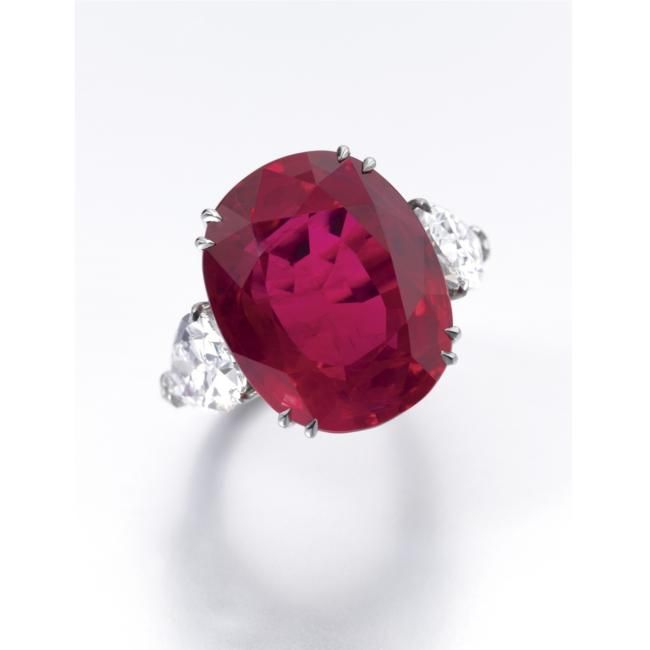 |
The first was a 30.20 cushion ruby, mounted in a ring, selling for over $4.2 million or almost $140,000 per carat. It looks red but windowed from the catalog photo.
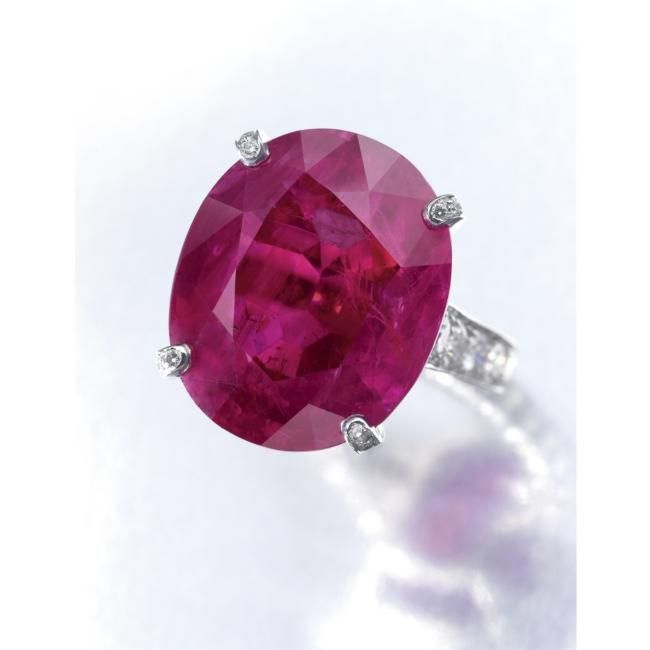 |
Also, a 29.40 oval ruby also sold for over $1.4 million or about $47,000 per carat. The second stone had poorer color and was included. These rubies were not the top quality that we have seen selling recently at auction but sold because of their large sizes.
An 8.64 octagonal Kashmir sapphire dating from the 1930's, sold for $463,418 total or slightly over $53,000 per carat.
Sotheby's Hong Kong
Highlights:
* A 26.67 carat, Burmese ruby cabochon and diamond ring by Bulgari sold for $2.4 million or almost $90,000 per carat to an Asian private.
* A cabochon cats-eye alex sold for over $1.5 million or over $64,000 per carat to an Asian private. It had an AGL grading report stating Brazilian with no treatment.
Christie's Geneva
Highlights:
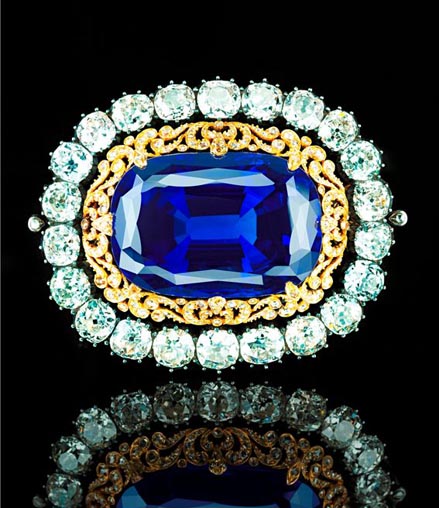 |
* An unheated 130.50 Burmese sapphire sold for over $7 million or $55,000 per carat to Ben Mellen and Son. This is a world record price for a sapphire at auction.
* A 6.60 rectangular fancy intense blue diamond, IF, sold for over $828,000 per carat or $5.2 million to a private.
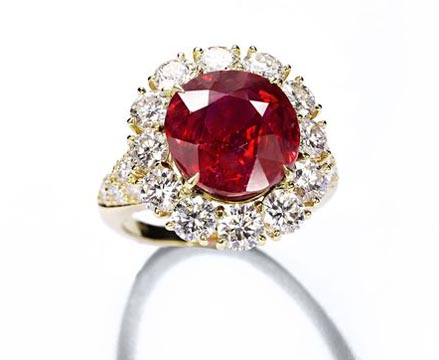 |
* A killer 8.53 cushion cut unheated Mogok Burma Ruby sold for over $2.2 million or $267,000 per carat to an anonymous buyer.
Christie's NY
Highlights:
* Recently, large pink diamonds have been one of the hottest stones at auctions. Prices have doubled from $500,000-$600,000 per carat to over $1 million per carat. Surprisingly, a 10.09 carat fancy vivid purplish-pink diamond failed to sell. It had a pre-auction estimate of $12 to $15 million. It is unclear why this gem did not sell. Some speculated the stone was misgraded or the timing was wrong.
* The 3.25 emerald-cut fancy vivid blue, IF, blue diamond sold for $3.67 million or $1.1 million per carat.
* A 6.61 rectangular-cut fancy intense pink diamond, VS2 , sold for $3.5 million or $540,000 per carat.
* A 50.29 cushion-cut fancy vivid yellow, VS1, diamond sold for more than $2.5 million or $51,000 per carat.
* A 10.06 Kashmir sapphire ring of by Tiffany & Co., circa 1920, sold for $746,500 or $74,000 per carat.
* A 40.66 cushion Burmese sapphire and diamond ring fetched $542,500 or $13,000 per carat.
Doyle New York
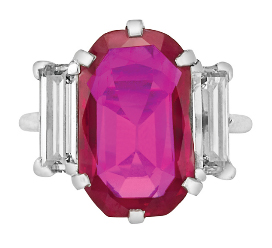 |
Doyle New York auctioned a 6.29 Burma ruby for $1.32 million or over $200,000 per carat during its Alice Appleton Hay estate jewelry sale on April 13. She was the the daughter-in-law of President Lincoln's private secretary John Hay. The ruby and diamond platinum ring was signed by Cartier and had a presale price of $60,000 to $80,000. The GIA report stated that the ruby was of Burma origin and that it held no indication of heating. This stone has really low brilliancy and seems to have reached this elevated price because of it's history.
Notable Quotes
"In this new climate, large colored and colorless diamonds, rare gemstones, and signed jewels are attracting an ever-expanding community of collectors and investors from around the world."
François Curiel, international head, Christie's
GIA,
April, 2011
"Spinel is a very rare stone, very beautiful, and it's now starting to get its due, I had never heard of people paying more than $3,000 per carat for it, but when Mahenge (Africa) came out, they started asking $10,000 per carat and I even saw someone asking $18,000 per carat."
Richard W. Hughes, gem author
New York Times
May 12, 2011
"There have been auction records for Kashmir sapphires, for colored diamonds, for Golconda diamonds, one after another over the last few years, Burmese rubies, Colombian emeralds. Of course, these, bear in mind, are auction records so that's only one portion of the market but there's no question that gemstones have increased in value."
Richard Wise, gem author
Advisorone
May 14,2011
Gem News
Return on Gems
Individual Investing
CXO Advisory
June 1, 2011
Do gems offer good returns? How do the returns of these tangible assets compare with those of other asset classes? In the April 2011 version of their paper entitled "Hard Assets: The Returns on Rare Diamonds and Gems", Luc Renneboog and Christophe Spaenjers examine recent returns on precious gems in U.S. dollars. They concentrate on the upper end of gem quality for three categories: white diamonds, colored diamonds and other gems (emeralds, rubies and sapphires). They consider gem attributes such as weight, color, clarity, cut, location of sale, auction house, brand and certification as allowed by subsample sizes. Using worldwide auction data spanning 1999 (the first year of representative coverage in the source database) through 2010 (3,952 total sales), along with the contemporaneous values of the U.S. Consumer Price Index and returns for other worldwide asset markets, they find that:
Over the entire sample period:
Transaction frequencies are 2,033 for white diamonds, 1,086 for colored diamonds and 832 for other gems.
White (colored) diamonds generate an annualized gross real return of 6.4%, compared to -0.1% for stocks, 3.3% for government bonds and 11.6% for gold. Negative gross real returns occur during subperiods related to the dot-com bust and the recent financial crisis, but subsequent rebounds more than compensate.
Based on gross Sharpe ratio, white diamonds substantially outperform stocks and match government bonds. Gem returns relate positively to stock market returns, suggesting a stock market wealth effect. Since 2003, annualized gross real returns are 10%, 5.5% and 6.8% for white diamonds, colored diamonds and other gems, respectively. Corresponding annualized gross nominal returns are 12.6%, 8.0% and 9.5%. Returns may be slightly greater on average, but also more volatile, for higher-quality gems.
In summary, evidence from a limited recent sample period supports a belief that gems tend to appreciate at rates roughly comparable to those of other asset classes.
As noted in the paper, the sample period is short, especially in terms of market shocks. Supply metering by the principal source of diamonds (De Beers) affects realistic return on investment calculations over long periods. Reported returns are gross, not net, and transaction costs for gem auctions (principally, the auction house commissions) are very large (on the order of 10% of price each way) compared to trading fractions for stocks, bonds and gold. While a long holding period would mitigate, these transaction costs would make net returns to investors materially lower.
A Precious Gems ETF?
Barron's
By Murray Coleman
May 25,2011
Precious metals are all the rage these days. But at least to Jeffrey Gundlach, apparently so should precious gems. The DoubleLine Total Return Bond (DLTNX) manager favorably compared gems to gold today at the Ira Sohn Investment Conference, according to a Dow Jones Newswires report.
The report came with a headline: "How Long Before There's A Precious Gems ETF?"
Gundlach believes that while gold has proved itself to be as valuable as money, precious gems have those properties and are "even prettier," the piece reports.
Gundlach also remarked at the conference that the problem with gold is its lack of portability: "You can carry a $25,000 gem in your shoe, with your foot still in it."
He added: "Gold doesn't have negative carry, but (you) can't carry (it)."
False Promise
Barron's
By Susan M. Neider
May 21, 2011
As we have always said, do not buy a diamond without a GIA report and do not buy a colored gemstone with out an AGL grading report. However, don't mix the two stones and reports. - Editor
In January of last year, I was offered a spectacular natural alexandrite, a rare color-changing gem that is among the most expensive on the planet. An oval of diamonds surrounded the gorgeous stone, all set on a classic Tiffany & Co. platinum ring. A Philadelphia jeweler, with whom I'd done business, had bought it several weeks earlier from a well-dressed woman selling her mother's estate. To be prudent, the jeweler made his purchase contingent on an inspection by the Gemological Institute of America and the issuance of a GIA Lab certificate stating the alexandrite to be of natural origin, not man-made.
My eyes popped at its luscious beauty. At last, an essential prize for my gem portfolio. A world-class alexandrite with a world-trusted GIA certificate. What could go wrong? Everything, as it turned out. After certifying the alexandrite as natural, the GIA ultimately reversed course, concurring with another lab's analysis that the gem was a fake; it was possibly the creation of rogue scientists. What follows is a cautionary tale for anyone buying jewelry with expensive gemstones. Even if you're shopping at big, brand-name jewelers, it's wise to do a little probing. The good ones stand ready to help you.
Top-quality natural alexandrites can cost more than $30,000 a carat. The stones are millions of times more rare than diamonds. They look like nothing else: Traces of chromium cause two distinct colors to flash from the gem: green in daylight, red in incandescent or candlelight.
The alexandrite in the Tiffany-stamped ring looked totally clean. I could not see any flaws, even with my 10-power loupe. At its greenest, it resembled a bluish emerald with intense green flashes; at its reddest, a fiery amethyst or garnet. The hues were pure. No bleeding of colors, no brown or gray undertones. It seemed perfect.
As a trained chemist and experienced gem collector, I did wonder for a moment if the gem was too perfect. But it came with a GIA certificate, which I trusted.
Relied upon by the gemstone industry since 1931, the GIA is considered the world's foremost authority on diamonds, colored stones and pearls. The dimensions and description of the stone listed on the GIA certificate matched what I held in my hand and then measured with my gauge. Printed clearly were the coveted words, "Species: Natural Chrysoberyl; Variety: Alexandrite."
The jeweler removed the alexandrite from its mounting and weighed it: 2.54 carats. We settled on a price of $10,000 for the whole ring. It seemed too cheap to me, yet somehow too expensive. I studied the GIA certificate again. Then with a handshake, the ring was mine.
When I got home, my first order of business (and that of every serious gem buyer) was to call the GIA and verify the authenticity of the certificate. Each document issued by the GIA has a report number, and it's important to check that this number matches what the GIA has on record. Counterfeit certificates float in the shadows of this industry. Even when a GIA certificate is obtained, a valuable natural gem can be removed from its mounting and replaced by a lab-created lookalike that has been cut by laser to match the original.
Donna Beaton, manager of colored-stone services, confirmed that the GIA New York Lab had indeed examined and issued a report on a natural alexandrite. Their report number matched mine, as did the description of the stone.
I asked Beaton directly about the gem's stunning clarity, which was unusual for alexandrite. She told me GIA gemologists had also noted a very clean and transparent stone, but assured me that visible under magnification were an assortment of "natural inclusions" - the trade term for the tiny flaws that occur in nature and are proof that a gem is not man-made.
To estimate the value of my alexandrite, I needed to know its country of origin because gems from certain mines are especially pricey. Only a few labs are willing to make this determination for alexandrite, and the GIA is not one of them. But five floors above the GIA lab, in the same building on New York's Fifth Avenue, is American Gemological Laboratories, founded in 1977 by C. R. "Cap" Beesley, a world-renowned gemologist with nearly half a century of experience. The opinion of this lab can change the price of a gem by tens of thousands of dollars, particularly for rare varieties such as alexandrite.
While alexandrite occurs in locations such as Brazil and Sri Lanka, the prized specimens are those from ancient mines in Russia's Ural Mountains, where the gem was discovered in 1834 on Czar Alexander II's 16th birthday. When miners poured out the emerald-colored crystals they had mined that day, the evening campfire light showed them as brilliant violet-red. Green and red were the colors of imperial Russia.
In the late 19th century, Tiffany & Co. collected as much Russian alexandrite as it could buy. Superior Russian stones in diamond settings were offered by Tiffany for many decades after the Ural mines were played out. A top-quality natural alexandrite set by Tiffany is more likely than not to be of Russian origin. Was my magnificent ring such a Tiffany jewel?
Authenticating jewels can require detective work. I photographed the ring and its Tiffany mark, and e-mailed the pictures to a Tiffany & Co. bench jeweler and to jewelry historian Janet Zapata. Both experts agreed that the Tiffany mounting and the mark appeared genuine. But there was no way to know whether Tiffany had mounted the stone.
I went to Manhattan to deliver the ring to Chris Smith, the current head of AGL. To enter the building of the AGL and the GIA, you must pass through a controlled turnstile, provide a driver's license and leave a fingerprint. Brinks Security has an outlet in the lobby. Inside, men in dark overcoats hustle along the hallways, speaking in code to one another or their cellphones. After passing through two sets of bulletproof doors, I left my ring with AGL.
A few days later, my phone rang: "Hi Susan. This is Chris Smith from the AGL. Your alexandrite is synthetic."
"Synthetic? As in...not real? How can this be - it has a GIA cert!" But I knew he was right. That stone really did look too perfect.
When two well-respected labs disagree on a matter this fundamental, it is necessary to establish that both labs examined the same stone. I called the GIA and told Beaton that the AGL had contested their findings. Still, the GIA stood by its decision. At least two GIA-trained gemologists had agreed that the alexandrite they examined was earth-born. The lab suggested that I send the stone again with its original GIA certificate, to rule out the possibility of a stone swap.
After a week, the GIA rendered a new verdict: The alexandrite was indeed the same stone submitted in December... and upon review by its senior gemologists, the GIA reversed itself and declared the stone to be synthetic. In other words, the world's leading authority on gemstones was admitting it had made a fundamental mistake. And had I not been curious about the country of origin, I might never have known.
In Philadelphia, the jeweler who had purchased the ring was beside himself. Like me, he had wondered if this flawless and intensely beautiful alexandrite was all that it seemed to be. But on word from the GIA that the gemstone was natural, he had paid the woman $7,000 cash. The jeweler promptly refunded my $10,000. It was clear to us that someone, somewhere had placed a fake gem in a Tiffany mounting or, worse, counterfeited the entire thing from scratch.
I couldn't stop wondering how the GIA had slipped up. "There are people out there doing everything they can to fool the GIA," said Tom Moses, the group's senior vice president for laboratory and research. "The financial rewards are enormous and the incentive is high. We have the good fortune to have the most resources of any lab, but it's a speck of dust compared with what the industrial world has to enhance gems and make them impossible to detect."
Impossible? I was intrigued, so I began to read. Years ago, a type of synthetic alexandrite was marketed under the trade name Allexite. The manufacturer was the House of Diamonair, a subsidiary of Litton Airtron (today part of Northrop Grumman Aerospace Systems). Under shortwave ultraviolet light, the synthetic stones fluoresce chalky yellow mixed with a weak red-orange. The authentic counterpart is inert.
I raced to the basement and plugged in my ultraviolet lightbox. Sure enough, I could see the fluorescent glow clearly, like a ring of hot yellow powder outlining the alexandrite...or should I say, the Allexite?
I asked the GIA's Moses about the analytical techniques used by his lab to distinguish natural from synthetic alexandrite. He confirmed that infrared light would reveal differences. Unfortunately, in the case of my stone, the GIA hadn't performed that test. "As gut-wrenching as it is to make a mistake," he said, "fortunately, it only rarely happens."
"How rarely?" I asked.
"The vast majority can be identified in our experience," he responded. A precise answer was difficult, he said, because some makers of synthetics share information with the GIA, but others worked underground and covertly leak their products on the market.
To the AGL's retired founder, Cap Beesley, however, the lesson was clear. "Unfortunately, there are some people who still believe that GIA stands for 'God In Action,' " he said. "Laboratories need to realize that arrogance has no place in the gemological process. Gem buyers need to be more vigilant about protecting their interests, rather than relying on PR, marketing hype and dealer rhetoric."
Though the Philadelphia jeweler was gracious enough to take back the ring and give me a refund, not all jewelers would have done that. And, if my jeweler sold it again as a clearly labeled synthetic gem, there's no telling how the buyer might have tried to resell it. That stone might be making the rounds as prize possession for an unknowing buyer. Don't be that person.
Inside Ralph Esmerian's Downfall
Rapaport
By Ricci Dipshan
June 1, 2011
Ralph Esmerian was always considered a gem dealer's gem dealer. Regretfully, this riveting account depicts how a New York dealer can get in over his head and go bad. -EDITOR
The American Folk Art Museum's Senior Curator Stacy C. Hollander once wrote that "to enter Esmerian's world is to abandon one's usual mundane considerations. All that matters is quality, beauty, rarity and the creative song of the individual's hand at work." A Paris-born, French-Armenian, fourth-generation gem dealer, Ralph Esmerian was once a revered figure in the diamond and jewelry world, a collector whose antique and rare items were almost legend, decorating the walls of the Louvre and the American Folk Art Museum. "He exemplified the presence of a royal nature to the gem industry," noted colored diamond expert Alan Bronstein of Aurora Gems, an appraiser for the colored diamonds involved in Merrill Lynch's bankruptcy case against Esmerian. "He was a genius at recognizing gems but he got caught in an ever-greater, grandiose desire fed by the world of cheap finance. He made a lot of foolish mistakes."
While Esmerian's world may have centered around aesthetics and beauty, his downfall focused on a recklessness and naïveté in all matters financial, leaving the once-crowned king of collectors facing jail time. The undoing of one of the diamond and jewelry industry's most renowned figures followed a dramatic and scandalous turn of events that many attribute to his resounding lack of business acumen.
"In certain instances, he obviously used poor judgment," said Audrey Friedman, owner of New York-based Primavera Gallery. "I think a certain amount of it may have been due to inexperience in business, but he also might have been poorly advised by other people, and reaching a point where he was in desperate straits and not sure what to do."
Esmerian was arrested in November 2010 and pled guilty to charges of bankruptcy fraud, wire fraud and concealing assets in connection with a scheme to embezzle funds. He entered the plea in a New York courtroom in April 2011, marking not only the end of his professional career, but also the end of several tense years spent trying to outpace his debt and regain financial solvency. On July 22, 2011, Esmerian will be sentenced for his crimes, for which he faces eight to thirty years in prison. At the time of his sentencing, as required by the court, he will remit all capital owed to his victims, and give up claims to all property or proceeds involved in his offenses.
Attempts to contact Esmerian for this story were unsuccessful, with neither he nor his attorneys offering public statements on his past crimes or his impending sentencing.
Road to Auction
The seeds of Esmerian's downfall were planted in the fall of 2005 and the spring of 2006, when he decided to buy retail estate jeweler Fred Leighton from retiring owner Murray Mondschein, securing two loans from Merrill Lynch totaling $177 million to finance the purchase. These loans were backed in part by the jewelry and rare items he had accumulated through his company, R. Esmerian, Inc. (REI), which, according to court documents filed later, held inventory valued at around $192 million. In an indication that Esmerian was overextending himself financially, in December 2006, he pledged the same collateral - REI's inventory - to Acorn Capital Group LLC to secure another loan in the amount of $40 million, an illicit activity known as double-pledging.
To run Fred Leighton, Esmerian hired Peter E. Bacanovic, a former Merrill Lynch broker most famous for serving five years in prison for his role in the Martha Stewart insider trading case. It is not clear whether Bacanovic played an instrumental role in securing the Merrill Lynch loans for Esmerian, though it has been the subject of much speculation. During Bacanovic's time at Fred Leighton, however, the retailer went downhill - in 2008, it defaulted on its loan obligations, freeing Merrill Lynch to auction off at Christie's the items Esmerian had put up as collateral.
Interestingly, the auction, which was first set to take place on April 15, 2008, then postponed to the following day, did not mention Esmerian by name, instead describing the items as belonging to an "American Connoisseur." Prior to the sale, a furious Esmerian charged Merrill Lynch and Christie's with selling his items at prices that were "dangerously low." While not all agreed with Esmerian's complaint, there were many who questioned why the bank had never confirmed the value of the items before granting the loan. One off-the-record source wondered, "Why didn't Merrill Lynch do its due diligence and get a second appraisal on the jewelry? The guys over there were just interested in getting their commissions on the loan, so they went with what they were given." Indeed, it isn't hard to see how Merrill Lynch - which was itself imploding in the subprime scandals that began in 2007, and was just four months away from being sold to Bank of America - could have been out to make quick capital with the Christie's auction.
To prevent Christie's from going through with the auction, Esmerian had Fred Leighton file for bankruptcy. That legal end run confounded auctioneers at Christie's, who canceled the "American Connoisseur" sale - much to the ire of those awaiting the chance to bid on Esmerian's goods. A few days after the aborted auction, however, Christie's struck a deal with Esmerian to sell a 141-carat diamond brooch that belonged to Empress Eugenie, wife of Napoleon III, to the Louvre Museum for $10.6 million. Members of the Esmerian family, however, refused to sign off on the deal. Jacqueline Esmerian King, Esmerian's sister, along with three of his other siblings, filed a suit alleging that the brooch belonged to a family trust set up by their late grandmother, and that the sale was, in effect, illegal. That case is still pending, though the brooch remains at the Louvre.
Other auctions featuring some of Esmerian's inventory have sprouted up occasionally since 2008, including an October 2009 auction at Christie's. Private auctions of Esmerian's inventory also have occurred, with the most recent sale, featuring 56 items, being held through June 27, 2011. Proceeds from that sale will go to firms comprising the Acorn Capital Group LLC.
Esmerian and Friends
Around the same time that Esmerian secured his second loan from Merrill Lynch - still part of the $177 million total - in the spring of 2006, he entered into a deferred jewelry purchase agreement with the limited liability company (LLC), Jeweled Objects. The LLC was owned and operated by Esmerian's longtime business adviser Mitchell May, with whom he had shared office space since 2006, and Robert Hoberman, his accountant for more than 15 years. With the ink on the new Merrill Lynch loan still wet, Esmerian sold 38 pieces of REI's inventory, including jewelry, sculptures and antiques, for $8.95 million to Jeweled Objects, with the contractual obligation to buy it back in one year at 20 percent interest. At least six of those 38 items were designated as Fred Leighton debtor property and already were promised to Merrill Lynch.
As it turned out, Esmerian wasn't the only one who needed to borrow money to finance deals. To fund its initial purchase of Esmerian's 38 items, Jeweled Objects raised $5.25 million from an eclectic mix of investors, including charitable organizations and retirement funds. Investors were told by the company that the collateral value of the 38 items was actually more than three times the purchase price. Should Esmerian fail to repurchase or lease his items back, Jeweled Objects argued, the investors would be sitting on more than $28 million in security. As the investors would soon find out, however, their security against an Esmerian default was more smoke and mirrors than actual value - in the end, the collateral was really worth less than 2 percent of the price Jeweled Objects had established.
In May 2006, Benjamin Zucker, president of Precious Stones Company, appraised 20 of the 38 items for just shy of $24 million - a price that his appraisal document said represents "a fair market value for objects that have a provenance of being acquired and collected 50 years ago." The other 18 objects were appraised for around $4.8 million, though the appraiser for those items has not been identified.
In court papers filed against Jeweled Objects in March 2010 by investors seeking to recoup their losses, Esmerian, Zucker, Hoberman and May are accused of employing a "highly subjective methodology" in their appraisal by using the prices of "particular, idiosyncratic potential buyers," who would pay above and beyond market price for the items, to justify their inflated value. An August 2009 Christie's appraisal of the 20 items that Zucker had pegged at $24 million set the market value for the items at $432,500.
Richard Lawler, president of GBC Inc., a Boston-based jewelry surplus wholesaler and appraisal company, said that in his dealings with Esmerian, he too found a significant difference between Esmerian's values and those that could be realistically recovered by a lender. "In all of our appraisals on manufacturers and wholesalers, we have never run into a situation where there has been a meaningful disagreement with our findings by either party. Predating this case, we had experience with the inventory that was owned by Esmerian. It went well beyond even the exclusive Fred Leighton merchandise. The value placed on those unique historic pieces by Esmerian, by his insurance companies and by his appraisers, was considerably higher than its worth to the lenders. GBC knew this but apparently the lenders did not. They could have circumvented a big part of their problems by having a proper appraisal done on the collateral before entering into the loan arrangement."
Lawler, whose company had no knowledge of the defendants or their appraisals for Esmerian, went on to say that, "the phrase 'fair market value' is always open to a significant range of interpretation and should be carefully considered before being accepted by a lender."
Why investors believed that Esmerian's items were worth over 50 times their value reflects Esmerian's stature as a revered figure in the industry. "Esmerian came from a family that was extremely well known and well respected in the industry and I think that everybody just assumed that Ralph was extremely rich. Not many people in the industry knew what he owned and didn't own," observed Donald A. Palmieri, president of the Gem Certification and Assurance Lab (GCAL).
Esmerian's reputation, however, could not save him when the bills came due. While Esmerian did make some payments to Jeweled Objects to repurchase his items, he and the company agreed to push the final due date for repayment back by one year in March 2007, and then again in March 2008. Each time, Jeweled Objects collected additional collateral from Esmerian's personal assets, including some of his folk art paintings and antique furniture. In March 2010, when Esmerian's financial troubles became public, and Jeweled Objects investors realized their collateral was wholly undervalued, they sued the company, Esmerian and Zucker for damages in excess of $50 million.
Jeweled Objects, which declared bankruptcy a month after the suit was filed, had filed its own court papers earlier in October 2009, seeking to recoup $7.4 million in losses from Esmerian. The company's investors quickly dismissed the filing as an attempt for Jeweled Objects to appear legitimate after conspiring with Esmerian to defraud them out of their capital. As evidence, they point to the fact that May and Hoberman assisted Esmerian in obtaining the loans from Merrill Lynch, while collecting substantial finders' fees for themselves. They also claim that the two had intimate knowledge of REI's finances. While May and Hoberman have not denied their knowledge of REI and its accounting, they do insist that they were never acquainted with Fred Leighton's books or its financial state.
There is, as of yet, no legal connection establishing Esmerian, May and Hoberman as conspirators. But there is, however, evidence to suggest that dealings among them were informal and off the books. In May of 2006, the same month the deferred jewelry purchased agreement was signed, Jeweled Objects consigned one of the 38 purchased items, a 9.77-carat emerald ring, to Fred Leighton, and Esmerian soon sold the ring to an individual for $250,000, keeping the profits for himself. Jeweled Objects eventually reported the lost income from the ring in their court case in 2009, but did not take any legal or public action against Esmerian prior to that time.
Scramble
Furtive one-on-one sales, as in the case of the emerald ring, were characteristic of the way Esmerian double-pledged his items - and the way he got more and more entangled in bankruptcy and wire fraud. The most famous example is Esmerian's sale of a pledged Endymion butterfly brooch in May 2008 for $2 million. After wiring half of the profit to his personal Swiss bank accounts, he learned through Merrill Lynch that his buyer had put the brooch up for auction at Christie's Hong Kong, pricing it at $3.2 million. Forced to buy the item back at auction, Esmerian went about frantically selling off other inventory to raise the capital, including more items that were Fred Leighton collateral, as well as a brooch and pendant that legally belonged to a private collector and longtime customer of REI.
In his double-pledging and double-selling, a portrait emerges of Esmerian as a deceitful swindler who carelessly tried to cover his tracks. In July 2008, for example, he sold a pledged 13-carat Burma ruby diamond ring for $2 million through wire transfer to his personal bank account. A year later, he testified in bankruptcy proceedings that the ring was in a vault at REI's Manhattan offices, and that he "had an offer," which he "turned down yesterday" from a potential buyer. Esmerian became so caught up in his web of debt that by the end of 2009, he pledged shares of his apartment to an individual in exchange for forgiving him a $3 million outstanding balance. He failed, however, to notify a business adviser of his, who just four months prior, was given 50 percent of his apartment shares.
Given Esmerian's fall during the collapse of the financial industry, it is hard not to see some of his problems as part of the larger problems of easy credit and backroom financial deals. "He was really caught in this web," said Bronstein, adding that "there are a lot of other people who got caught it in, too, but they are not as big as Esmerian." Many, however, argue that whatever the circumstance, Esmerian sealed his own fate by participating in illicit transactions. "If he is committing fraud and claiming it's consignment, and it's not - that is just plain fraud," said Cecilia Gardner, president and chief executive officer (CEO) of Jewelers Vigilance Committee (JVC).
To a certain extent, Esmerian's downfall exposes cracks in an industry that handles transactions based on trust. Primavera Gallery Owner Friedman, for example, noted that "the jewelry industry is an industry where people do millions of dollars in business deals with a handshake." It remains to be seen whether the Esmerian scandal will force the industry to think of itself as a place where, according to Bronstein, "there are few checks and balances like there are in other industries in keeping track of what belongs to whom."
Esmerian's downfall has reverberated well beyond its initial participants, leaving a lasting impact on the industry that could affect business for years to come. "It is important to realize that the victims of this case are not only Merrill Lynch and Acorn Capital," observed Lawler. "Also affected are the vast majority of companies in the jewelry and diamond industry that rely upon banks and other lending institutions to fund their business."